Semaglutide vs tirzepatide which is better for weight loss
Semaglutide vs tirzepatide which is better for

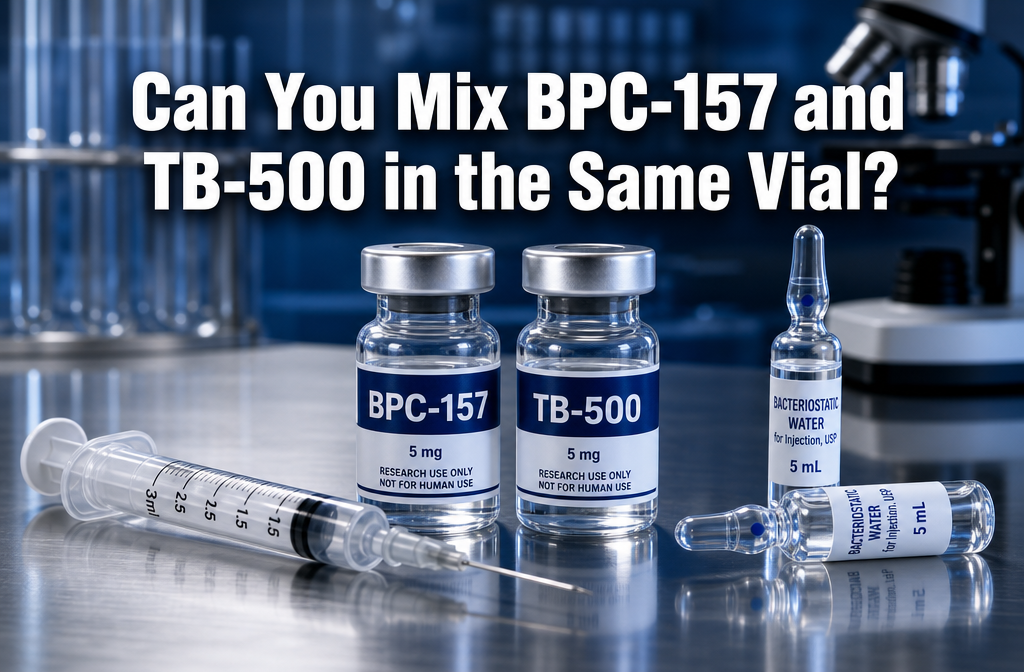
Quick Answer: Yes, BPC-157 and TB-500 can technically be combined in the same vial, and pre-mixed blends are commercially available for research purposes. However, most laboratory professionals recommend reconstituting each peptide separately to preserve individual stability and allow independent dosage adjustment. Co-administration via the same syringe immediately before use is widely considered the preferred approach for combining these two compounds in research protocols.
BPC-157 (Body Protection Compound-157) is a synthetic 15-amino acid pentadecapeptide derived from a protective protein found in gastric juice. TB-500 is a synthetic analogue of Thymosin Beta-4, a 43-amino acid peptide. In preclinical research, both compounds are investigated for their roles in tissue repair and regeneration, but through distinct biological pathways.
BPC-157 promotes angiogenesis through VEGFR2 activation, modulates nitric oxide synthesis, and activates FAK-paxillin signalling pathways involved in cellular repair. Laboratory investigations have explored its role in tendon and ligament healing, gastrointestinal mucosal repair, neurological recovery, and anti-inflammatory models. TB-500, by contrast, binds to actin monomers (G-actin), promoting cell migration, tissue remodelling, and stem cell differentiation. Research has examined its applications in wound healing, cardiac tissue repair, musculoskeletal recovery, and neurological regeneration [4].
Because their mechanisms operate on different but complementary biological targets, the BPC-157 and TB-500 combination — sometimes referred to as the “Wolverine Stack” in research circles — has become one of the most studied peptide pairings in cellular regeneration and recovery research. For a broader overview of research-grade recovery compounds, see Sempica’s research peptide stacks catalogue.
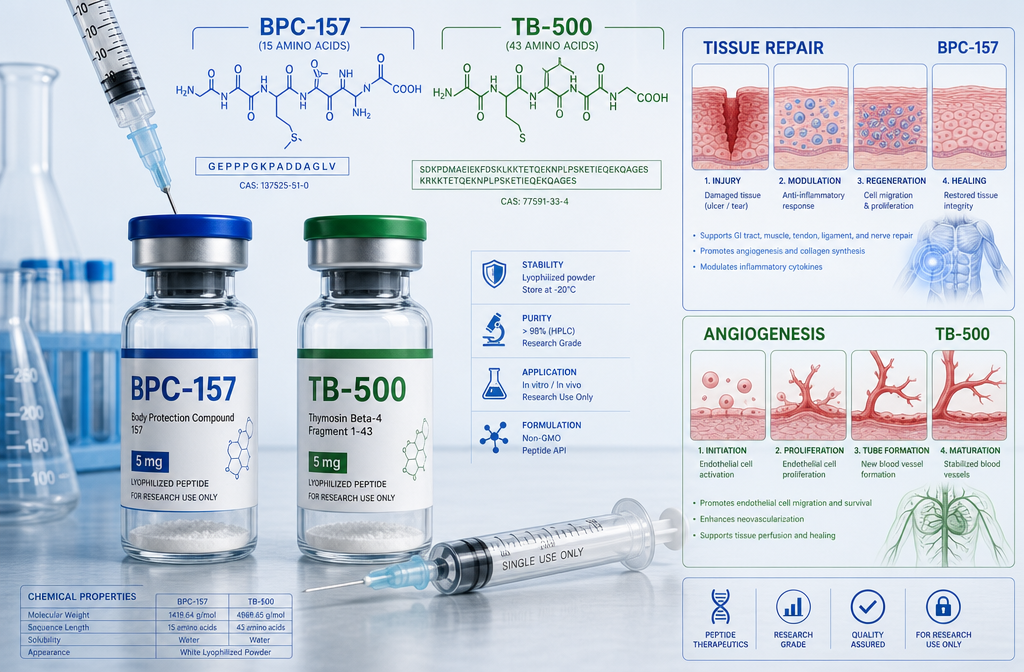
The short answer is that it is physically possible, and pre-mixed products exist, but the scientific consensus leans toward separate reconstitution as the more rigorous approach. Pre-mixed vials containing equal amounts of both peptides — for example, a 10mg vial with 5mg of each — are commercially available and marketed for their convenience [1]. However, several laboratory professionals and compound suppliers advise against long-term co-storage in a single vial due to stability considerations [5].
The core concern is that BPC-157 and TB-500 have different optimal pH ranges and slightly different storage sensitivities. When combined in one vial over days or weeks, there is a theoretical risk that one compound’s degradation could be accelerated by the presence of the other [6]. This is not a dramatic chemical incompatibility, but it is a variable that rigorous research protocols aim to eliminate.
The preferred compromise, used by many research professionals, is to reconstitute each peptide in its own vial and then draw both into the same syringe immediately before use [3]. This approach preserves the integrity of each compound during storage while still allowing single-administration convenience.
Decision rule: Use a pre-mixed vial if protocol simplicity is the priority and dosage ratios are fixed. Use separate vials if independent dosage titration or maximum stability is required.
Both peptides are most frequently studied in the context of musculoskeletal repair, wound healing, and anti-inflammatory research. Their complementary mechanisms make the combination particularly relevant in research models involving tendon injuries, ligament damage, muscle tears, and connective tissue remodelling [4].
BPC-157 is especially prominent in gastrointestinal research models, where its gastric origin gives it particular relevance to mucosal repair. TB-500 has been more extensively studied in cardiac tissue repair and neurological regeneration contexts, where its role in actin regulation and stem cell activation is of significant interest. Together, they cover a broad spectrum of cellular regeneration pathways that neither compound addresses as comprehensively alone.
Research areas where this combination is most frequently investigated include:
For researchers exploring related cellular regeneration compounds, the Wolverine Stack (40mg) and the Klow Stack blend are pre-formulated options that include both BPC-157 and TB-500 alongside complementary compounds.
In preclinical research, combination protocols frequently demonstrate broader or more pronounced effects than single-compound administration, particularly when the compounds act on different but synergistic pathways. BPC-157 and TB-500 represent a well-studied example of this principle: BPC-157 drives angiogenesis and activates repair signalling, while TB-500 facilitates the cell migration necessary to populate newly vascularised tissue [4].
This mechanistic complementarity means the two compounds address sequential stages of the tissue repair process. Angiogenesis creates the vascular infrastructure; cell migration and remodelling complete the structural repair. Research models that have examined both compounds together suggest the combination may produce more comprehensive tissue repair outcomes than either compound studied in isolation [6].
That said, combination research also introduces complexity. Attributing specific outcomes to one compound versus the other becomes more difficult, and dosage optimisation requires more variables to be controlled. For researchers prioritising mechanistic clarity, single-compound studies remain valuable alongside combination protocols.
From a research administration standpoint, drawing both peptides into the same syringe immediately before subcutaneous administration is widely considered acceptable practice [3]. The compounds do not produce known adverse chemical interactions when combined in solution for short periods, and this approach is used in established research protocols.
The distinction between co-injection (same syringe, used immediately) and co-storage (same vial, stored over weeks) is important. Co-injection carries minimal stability risk because the combined solution is used within minutes. Co-storage in a single vial introduces the pH and degradation variables discussed above [5][6].
Important compliance note: All references to administration in this article relate strictly to preclinical research protocols conducted by qualified laboratory professionals. Neither BPC-157 nor TB-500 is approved for human use. All Sempica compounds are sold exclusively for research purposes.
The primary risk of incorrect mixing is not a toxic chemical reaction but rather peptide degradation that reduces compound potency and research validity. Shaking a vial vigorously during reconstitution, injecting bacteriostatic water directly onto the lyophilised powder rather than down the vial wall, or storing a reconstituted solution at incorrect temperatures can all compromise peptide integrity [2].
Specific risks associated with improper mixing technique include:
For a comprehensive protocol reference, Sempica’s laboratory guide to mixing and storing peptides covers reconstitution technique in detail.
After reconstitution, both BPC-157 and TB-500 should be stored at 2-8°C and used within 4-6 weeks when bacteriostatic water is used as the diluent [2]. Bacteriostatic water contains 0.9% benzyl alcohol, which inhibits bacterial growth and extends the usable life of the reconstituted solution compared to sterile water, which should only be used for single-dose applications.
When both peptides are combined in a single vial, the same 4-6 week window applies as a maximum, but the stability may be shorter in practice due to the pH interaction variables noted above [6]. Lyophilised (unreconstituted) powders stored at -20°C remain stable until their expiry date and are not subject to the same degradation timeline.
For detailed guidance on reconstituted peptide shelf life, see the Sempica reference article on how long reconstituted peptides last in the fridge.
| Storage Condition | BPC-157 | TB-500 | Combined Vial |
|---|---|---|---|
| Lyophilised at -20°C | Stable to expiry | Stable to expiry | N/A |
| Reconstituted at 2-8°C | Up to 4-6 weeks | Up to 4-6 weeks | Up to 4-6 weeks (potentially shorter) |
| Reconstituted at room temperature | Not recommended | Not recommended | Not recommended |
| Frozen after reconstitution | Avoid | Avoid | Avoid |
The most common errors in BPC-157 and TB-500 reconstitution involve technique, calculation, and storage — not the combination itself. Understanding these mistakes helps maintain compound integrity and research validity.
Reconstitution errors:
Calculation errors:
Storage errors:
For guidance on calculating accurate concentrations for research protocols, the Sempica article on how to calculate peptide dosage for research provides a practical framework.
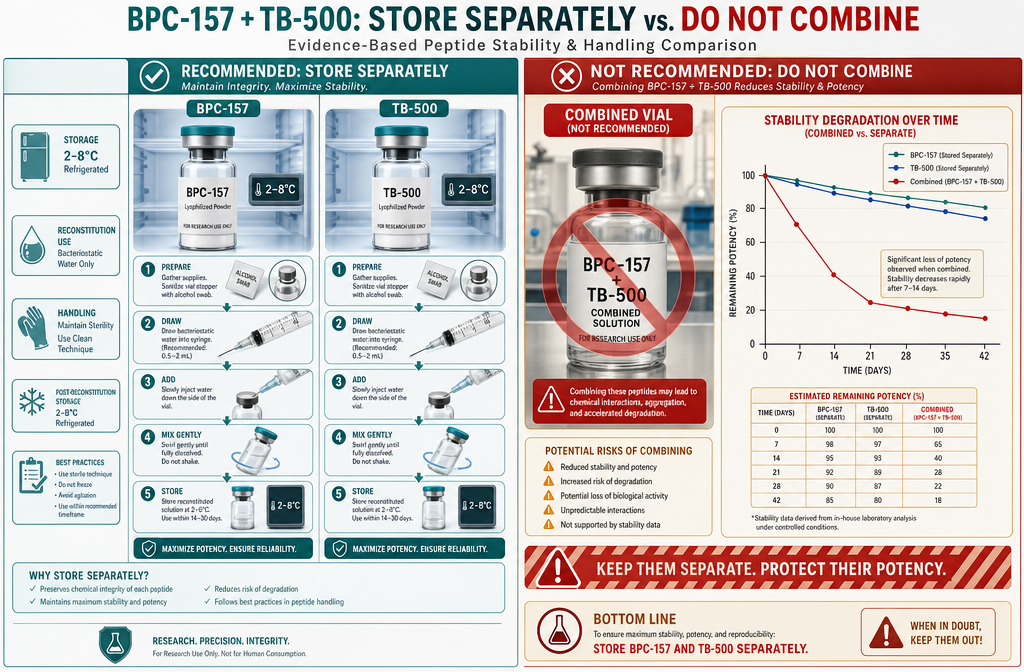
Both peptides share similar storage requirements, which is one reason their combination is logistically manageable. Lyophilised powders should be stored at -20°C, away from light and moisture, until the point of reconstitution. Once reconstituted with bacteriostatic water, solutions should be kept at 2-8°C (standard refrigerator temperature) and never frozen.
The key storage variables to control are temperature, light exposure, and moisture. Both compounds are sensitive to repeated temperature fluctuations, so minimising the number of times a vial is removed from refrigeration is advisable. Lyophilised BPC-157 is particularly sensitive to moisture exposure before reconstitution.
Preclinical research protocols studying this combination typically use different administration frequencies for each compound, which is one practical argument for separate vials. BPC-157 is commonly studied at 200-500 mcg administered once or twice daily, while TB-500 is typically investigated at 2-5 mg administered twice weekly [4]. These different frequencies mean a shared vial would be accessed at different intervals, complicating dosage tracking.
When separate vials are used, researchers can draw the required volume of each compound into a single syringe immediately before administration, achieving the convenience of a single injection without compromising individual dosage control [3]. This is the approach most consistent with both research rigour and practical efficiency.
These compounds are not appropriate for all research applications. Researchers investigating single-pathway mechanisms should use individual compounds to maintain experimental clarity. Combination protocols are most appropriate when the research question specifically addresses multi-pathway regenerative processes.
From a compound sourcing perspective, researchers should ensure they are working with independently tested, high-purity compounds with verifiable Certificates of Analysis. Using compounds without confirmed purity standards introduces confounding variables that undermine research validity. Sempica’s full catalogue of lab-tested research compounds provides independently verified purity documentation for all products.
Additionally, researchers should confirm compliance with their institutional review requirements and applicable regulations before initiating any peptide research protocol. Neither BPC-157 nor TB-500 is approved for human use in any jurisdiction as of 2026.
Both compounds are available from licensed research compound suppliers and, in some jurisdictions, from compounding pharmacies under prescriber order. For laboratory research purposes, qualified professionals can source high-purity BPC-157 and TB-500 from established suppliers who provide independent third-party testing and Certificates of Analysis.
Sempica Healthcare supplies both compounds individually and as part of pre-formulated research stacks, all tested to a 99.8% purity standard. Products are available through the Sempica online research compound store and shipped globally to qualified research professionals.
Can you mix BPC-157 and TB-500 in the same vial without any chemical reaction?
No harmful chemical reaction occurs when these two peptides are combined in solution. The concern is stability over time, not acute incompatibility. Short-term combination in a syringe immediately before use carries negligible risk.
What is the best diluent for reconstituting BPC-157 and TB-500?
Bacteriostatic water (containing 0.9% benzyl alcohol) is the standard diluent for both peptides. It extends the usable life of the reconstituted solution to 4-6 weeks when refrigerated. Sterile water should only be used for single-dose applications.
Does mixing these peptides in one vial reduce their effectiveness?
It may, over time. Different pH optima and degradation rates mean long-term co-storage could reduce the effective concentration of one or both compounds. Separate storage eliminates this variable.
Are pre-mixed BPC-157 and TB-500 vials reliable for research?
Pre-mixed vials are available and used in research, but they limit the ability to adjust individual peptide concentrations. Verifying the exact concentration of each compound in a pre-mixed vial requires independent testing.
How should a researcher draw both peptides into one syringe?
Reconstitute each peptide separately in its own vial. Calculate the required volume of each compound based on the desired dose and concentration. Draw the calculated volume of BPC-157 into the syringe first, then draw the calculated volume of TB-500. Administer immediately.
What purity standard should BPC-157 and TB-500 meet for research use?
A minimum of 99% purity is generally considered acceptable for research-grade peptides. Sempica compounds are independently tested to a 99.8% purity standard, with Certificates of Analysis available for verification.
Can these peptides be stored in the same refrigerator compartment?
Yes. Separate vials can be stored in the same refrigerator without any issue. The concern is combining the solutions within a single vial, not physical proximity during storage.
Is the BPC-157 and TB-500 combination legal to purchase for research?
In most jurisdictions, both compounds are legal to purchase for research purposes from qualified suppliers. They are not approved for human use. Researchers should verify the regulatory status in their specific country before purchasing.
The question of whether you can mix BPC-157 and TB-500 in the same vial has a nuanced answer. Technically, yes — pre-mixed vials exist and are used in research settings. Practically, separate reconstitution followed by co-injection via the same syringe is the approach most consistent with maintaining compound integrity, enabling independent dosage control, and upholding research rigour.
For researchers working with this combination, the recommended protocol is straightforward: reconstitute each peptide in its own vial using bacteriostatic water, store both at 2-8°C, calculate individual doses accurately, and draw both into a single syringe immediately before administration. This approach preserves the complementary benefits of both compounds without introducing the stability variables associated with long-term co-storage.
Actionable next steps for research professionals:
Products referenced in this article are intended for research purposes only. They are not for human consumption, medical use, or therapeutic application. By purchasing from Sempica Healthcare, you confirm that you are a qualified research professional and will use these products strictly for laboratory research.
[1] Bpc 157 Tb 500 Blend 10mg – https://peptideware.com/product/bpc-157-tb-500-blend-10mg/?utm_source=openai
[2] Mixing Tb500 Bpc157 – https://www.chempropharma.ca/guides/mixing-tb500-bpc157?utm_source=openai
[3] Bpc157 Tb500 Wolverine Stack Dosing Protocol Guide – https://peptigrity.com/blog/bpc157-tb500-wolverine-stack-dosing-protocol-guide?utm_source=openai
[4] Bpc 157 Tb 500 Stack – https://www.mypepcalc.com/learn/bpc-157/bpc-157-tb-500-stack?utm_source=openai
[5] Why Tide Labs Doesn T Mix Bpc 157 Tb 500 And Why Blended Vials Don T Add Up – https://tidelabs.co.uk/blogs/articles/why-tide-labs-doesn-t-mix-bpc-157-tb-500-and-why-blended-vials-don-t-add-up?utm_source=openai
[6] Can You Stack Bpc 157 Tb 500 – https://www.realpeptides.co/can-you-stack-bpc-157-tb-500/?utm_source=openai
Semaglutide vs tirzepatide which is better for
Confused on Retatrutide vs Tirzepatide for weight
What is Tirzepatide dual GIP GLP-1 agonist