Buy Semaglutide Research Peptide Online: A peptide for weight loss
Buy Semaglutide Research Peptide Online: A peptide

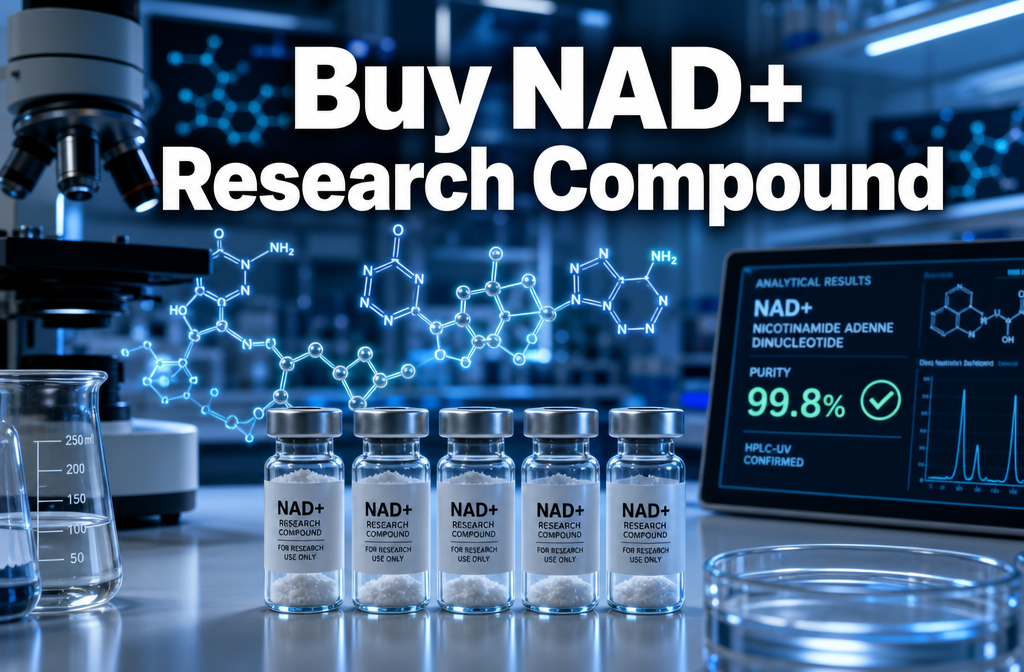
Quick Answer: NAD+ (nicotinamide adenine dinucleotide) is a research-grade coenzyme used in laboratory investigations of cellular ageing, mitochondrial function, and DNA repair. Qualified research professionals can buy NAD+ research compound from specialist scientific suppliers — such as Sempica Healthcare — where it is sold as a lyophilised powder at verified purity standards for in vitro and preclinical use only. It is not an approved drug or dietary supplement, and it is not intended for human consumption.
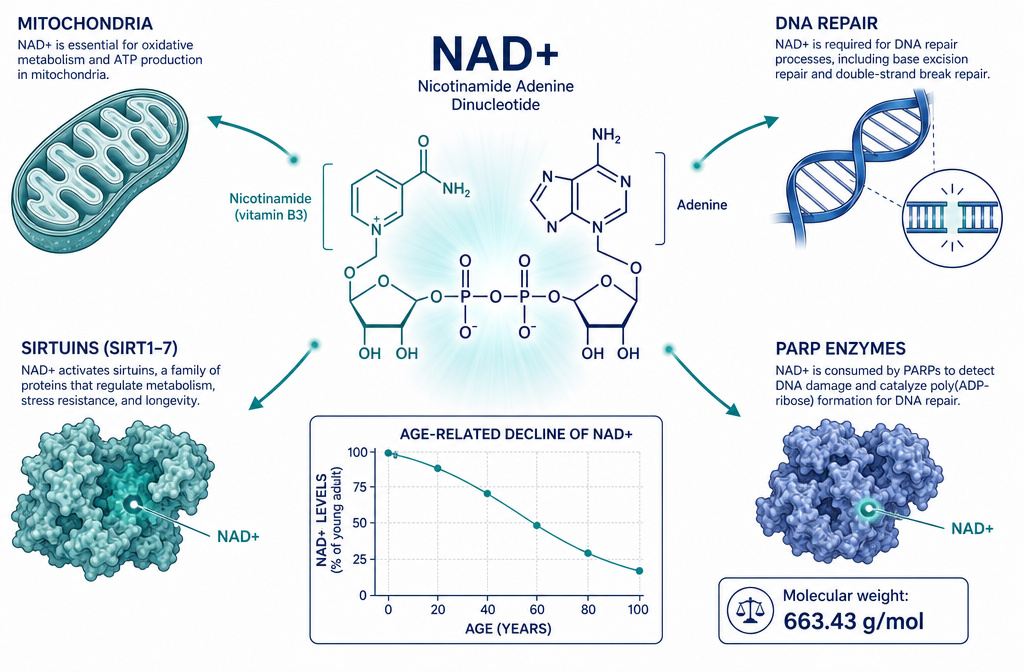
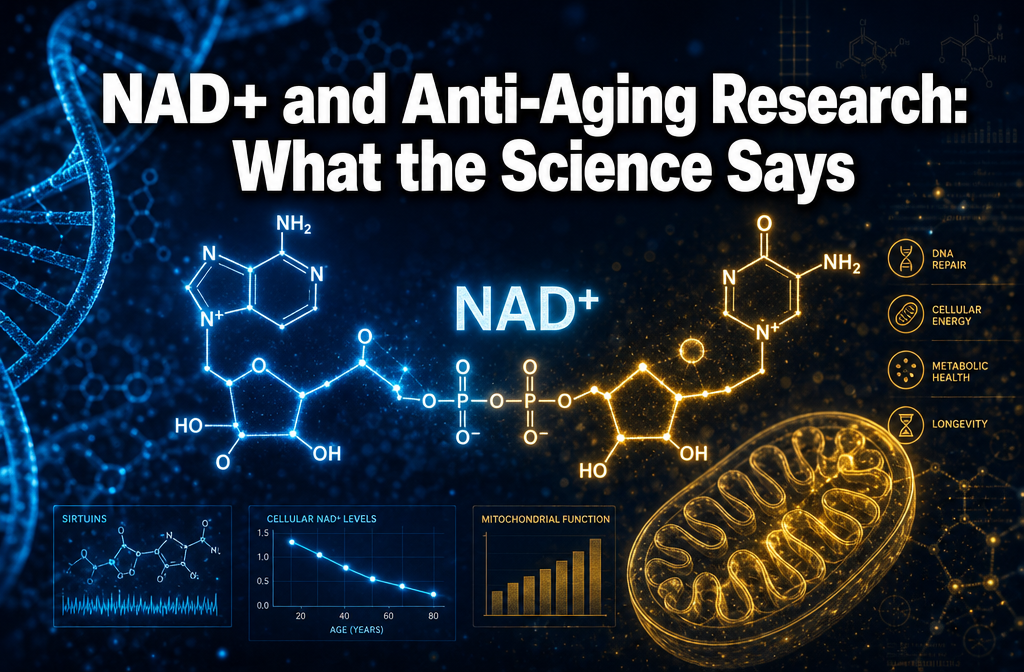
NAD+ (nicotinamide adenine dinucleotide, oxidised form) is a coenzyme present in every living cell, where it functions as an electron carrier in metabolic redox reactions and as a substrate for several classes of regulatory enzymes. Its molecular weight is 663.43 g/mol, and it exists in two interconvertible forms: the oxidised NAD+ and the reduced NADH.
Three mechanisms make NAD+ a priority compound in longevity and metabolic research:
1. Oxidative phosphorylation. NAD+ accepts electrons from glycolysis and the citric acid cycle, becoming NADH. NADH then donates those electrons to the mitochondrial electron transport chain, driving ATP synthesis. Without adequate NAD+, mitochondrial energy production is compromised.
2. Sirtuin activation. Sirtuins (SIRT1–SIRT7) are NAD+-dependent deacetylases that regulate gene expression, stress responses, and metabolic adaptation. They consume NAD+ as a co-substrate, meaning NAD+ availability directly governs sirtuin activity — a central axis in cellular ageing research.
3. PARP-mediated DNA repair. Poly(ADP-ribose) polymerases (PARPs) use NAD+ to detect and signal DNA strand breaks. High DNA damage load depletes NAD+ reserves, creating a feedback loop that impairs both repair capacity and energy metabolism.
NAD+ levels are reported to decline with biological ageing in multiple tissue types, though a 2026 study published in Nature Metabolism suggests that whole-blood NAD+ levels in healthy individuals may not decline as steeply as earlier models proposed [5]. This nuance is important: it means research into the tissue-specific dynamics of NAD+ depletion remains an active and unresolved area, making well-characterised research compounds essential for rigorous investigation.
For a deeper scientific overview, see Sempica’s dedicated resource on the molecular mechanisms of NAD+ in anti-ageing research.
Yes — NAD+ is legal to purchase as a research compound in most jurisdictions when bought from a compliant supplier and used strictly for laboratory research. It is not a controlled substance, and no blanket prohibition exists on its sale as a research reagent.
The critical legal distinction is how it is sold and what claims accompany it. Research-grade NAD+ sold with a “for research use only” designation, without therapeutic or anti-ageing claims directed at consumers, sits in a different regulatory category from pharmaceutical drugs or dietary supplements.
However, the regulatory environment around NAD-related compounds is not static. The FDA determined in 2022–2023 that nicotinamide mononucleotide (NMN) — a direct NAD+ precursor — had been investigated as a drug prior to its marketing as a supplement, which disqualified it from the US dietary supplement market [1]. This precedent matters: it demonstrates that regulators are actively monitoring the NAD+ compound space and are prepared to reclassify products if marketing crosses into therapeutic territory.
Practical guidance for researchers:
No specific FDA warning letter targets NAD+ research compounds sold to qualified laboratory professionals under research-use-only terms. However, the FDA has taken enforcement action against NAD+ IV infusion clinics and compounding pharmacies that market NAD+ with unapproved disease or longevity claims [2].
An NPR investigation from May 2026 confirmed that NAD+ IV drips — heavily promoted by clinics and public figures — are not FDA-approved for any anti-ageing, detox, or performance indication. Physicians interviewed noted that these infusions are unapproved uses supported largely by small, short-term trials [2]. Some IV clinics source NAD+ from 503B compounding pharmacies, but compounded NAD+ products remain classified as unapproved drugs and are subject to enforcement if marketed with prohibited claims.
The takeaway for research professionals: buying NAD+ as a research compound from a compliant supplier is legally distinct from purchasing or administering it as a therapy. Maintaining that distinction — in documentation, use, and communication — is essential.
NAD+ research compound is used across a broad range of laboratory disciplines. It is not exclusive to large institutional settings.
Primary research applications include:
Yes. Qualified research professionals working in private laboratories, independent research institutes, or contract research organisations can buy NAD+ research compound without university affiliation. The requirement is professional qualification and a confirmed commitment to research-use-only application — not institutional employment.
Sempica Healthcare supplies research compounds to qualified professionals across 100+ countries through a fully digital ordering platform. Purchasers confirm their qualified professional status at the point of sale. This model reflects the reality that advanced research increasingly takes place outside traditional academic settings.
Choose a private-lab-compatible supplier if:
For guidance on sourcing compounds responsibly, Sempica’s research guide on buying genuine peptides online for laboratory use covers supplier evaluation criteria in detail.
Research-grade NAD+ costs more per gram than consumer supplement versions. This price difference reflects independent third-party purity testing, CoA documentation, lyophilised formulation, and compliant research-use labelling — not just the raw compound.
| Product Type | Typical Purity | CoA Provided | Regulatory Status | Approximate Cost Range |
|---|---|---|---|---|
| Research-grade NAD+ (lyophilised) | ≥99–99.8% | Yes (independent) | Research use only | Higher per gram |
| Consumer NAD+ supplement (capsule) | Variable, often unlabelled | Rarely independent | Dietary supplement (where permitted) | Lower per gram |
| IV clinic NAD+ infusion | Variable | Not typically disclosed | Unapproved drug use [2] | Highest per session |
A 2023 review in the Journal of Gerontology noted that consumer-market NAD+ and NMN products frequently show quality, labelling, and regulatory inconsistencies [1]. For research purposes, that variability is unacceptable — a compound with uncertain purity cannot produce reproducible data.
Sempica’s NAD+ 1000mg research compound is produced and independently tested to a 99.8% purity standard, with a CoA available for every batch.
NAD+ and NADH are the oxidised and reduced forms of the same coenzyme, respectively. For most research applications, the distinction matters significantly.
NAD+ (oxidised form) is the substrate consumed by sirtuins and PARPs, and the electron acceptor in catabolic metabolic reactions. It is the form most relevant to longevity, DNA repair, and sirtuin-pathway research.
NADH (reduced form) is the electron donor to the mitochondrial electron transport chain and is produced during glycolysis and the citric acid cycle. Research into mitochondrial electron flux and oxidative phosphorylation efficiency may require NADH.
For research exploring cellular ageing, NAD+ depletion, and sirtuin activation — the dominant focus areas in current longevity science — NAD+ is the appropriate compound. Researchers designing assays around mitochondrial redox state may need both forms, or may use NADH specifically.
Research note: A 2026 human trial directly comparing NAD+ precursors (NR, NMN, and related compounds) found differential effects on blood NAD+ levels depending on the precursor used [8]. This underscores why compound selection and characterisation matter — and why research-grade purity is non-negotiable for meaningful comparative data.
A 2026 PRISMA systematic review of NAD+-boosting interventions — covering NAD+, NR, NMN, and related compounds — concluded that while most trials report increases in blood or tissue NAD+ biomarkers, clinical benefits on physical performance, metabolic outcomes, or ageing endpoints are modest, inconsistent, and largely based on short study durations of four to twelve weeks [3]. The authors explicitly state that marketing claims in the longevity space far exceed the current evidence base, and call for larger, multi-year randomised trials [3].
This finding is important context for researchers: it does not invalidate NAD+ as a research target — it reinforces the need for rigorous, well-controlled laboratory investigation. The gap between biomarker elevation and meaningful clinical outcome is precisely the kind of question that preclinical and translational research is designed to answer.
Separately, a 2026 Nature Metabolism study challenges the assumption that whole-blood NAD+ declines uniformly with healthy ageing [5]. If confirmed in larger cohorts, this would require researchers to refine tissue-specific depletion models rather than relying on systemic NAD+ as a universal ageing proxy.
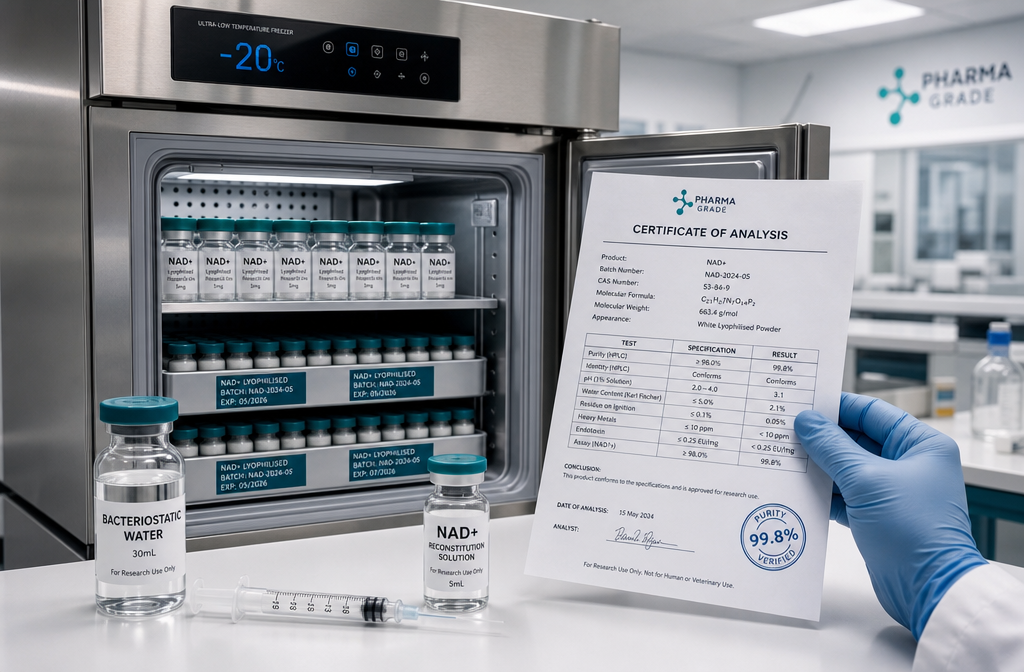
NAD+ is among the more environmentally sensitive research compounds. Improper storage degrades the compound rapidly, producing unreliable experimental results.
Storage requirements for lyophilised NAD+ powder:
Reconstitution protocol:
Never freeze a reconstituted solution. Freeze-thaw cycles degrade compound integrity and compromise assay reproducibility.
For a comprehensive protocol reference, Sempica’s laboratory guide on mixing and storing peptides provides step-by-step handling instructions applicable to NAD+ and related compounds.
Working with NAD+ research compound does not require specialist infrastructure beyond a well-equipped biochemistry laboratory. The following equipment is standard for NAD+ handling and assay work.
Essential equipment:
For downstream assays:
Researchers combining NAD+ with other longevity compounds — such as Epithalon for telomere biology studies or MOTS-c for mitochondrial pathway research — should ensure compound-specific storage conditions are maintained separately, as requirements may differ.
These errors appear consistently across laboratory settings and are worth addressing directly.
Ordering mistakes:
Handling mistakes:
The decision to buy NAD+ research compound should be based on verifiable quality criteria, not price alone. A compound with uncertain purity will produce unreliable data — the cost of a failed experiment far exceeds any saving on compound cost.
Supplier evaluation criteria:
| Criterion | What to Verify |
|---|---|
| Purity standard | ≥99% minimum; Sempica standard is 99.8% |
| Certificate of Analysis | Independent third-party testing, batch-specific |
| Regulatory compliance | Research-use-only labelling, no therapeutic claims |
| Storage and shipping | Cold-chain or lyophilised format with appropriate packaging |
| Global reach | Confirmed shipping to your country |
| Transparency | Clear contact information, published policies |
Sempica Healthcare meets all of these criteria, supplying NAD+ and 1,000+ other research compounds to qualified professionals across 100+ countries. All compounds are independently tested and supplied with batch-specific CoA documentation. Orders are processed through a fully digital storefront at sempicahealthcare.ch.
Researchers exploring complementary longevity compounds may also find value in reviewing Sempica’s endocrine and growth hormone research compounds and the broader metabolic and energy research compound catalogue.
Q: What does “research use only” mean for NAD+ compounds? NAD+ sold as a research compound is intended exclusively for use in controlled laboratory settings by qualified professionals. It is not approved for human consumption, self-administration, or therapeutic application. Purchasing confirms the buyer’s commitment to laboratory-only use.
Q: Is research-grade NAD+ the same as NAD+ in dietary supplements? No. Research-grade NAD+ is independently tested to a verified purity standard (e.g., 99.8%) with batch-specific CoA documentation. Consumer supplement versions have frequently shown quality and labelling inconsistencies and are not manufactured to research-grade specifications [1].
Q: Can NAD+ be used in human clinical trials? Human clinical trials require regulatory approval, institutional ethics review, and pharmaceutical-grade manufacturing standards. Research-grade NAD+ from a laboratory supplier is not manufactured under those conditions and is not appropriate for use in human subjects.
Q: How quickly does NAD+ degrade if stored incorrectly? NAD+ is highly sensitive to light, heat, and moisture. Exposure to ambient conditions — particularly humidity — can cause significant degradation within hours. Lyophilised powder stored at -20°C in a dark, dry environment is stable until the supplier’s stated expiry date.
Q: What is the difference between NAD+, NR, and NMN in research? NAD+ is the active coenzyme. NR (nicotinamide riboside) and NMN (nicotinamide mononucleotide) are biosynthetic precursors that cells convert to NAD+. Research comparing the three precursors directly found differential effects on blood NAD+ levels [8], making compound selection a meaningful experimental variable.
Q: Why was NMN removed from the US supplement market? The FDA determined in 2022–2023 that NMN had been investigated as a drug prior to its marketing as a dietary supplement, which disqualified it from the supplement category under US law [1]. This regulatory action is frequently cited as a warning for other NAD-related compounds marketed with human health claims.
Q: Does a Certificate of Analysis guarantee compound safety for human use? No. A CoA confirms the identity, purity, and potency of a compound as a research reagent. It does not constitute safety clearance for human administration. Research compounds are not manufactured under pharmaceutical GMP standards applicable to human medicines.
Q: How do I calculate the concentration of a reconstituted NAD+ solution? Concentration (mg/mL) = mass of compound (mg) ÷ volume of bacteriostatic water added (mL). For example, dissolving 100mg of NAD+ in 10mL of bacteriostatic water yields a 10mg/mL solution.
Q: Are there any known risks of working with NAD+ in a laboratory setting? NAD+ is a naturally occurring biological molecule with a well-characterised safety profile as a laboratory reagent. Standard laboratory safety practices — gloves, eye protection, sterile technique — apply. Researchers should consult their institution’s safety data sheets and follow local laboratory safety regulations.
Q: What is the current state of evidence for NAD+ in longevity research? A 2026 PRISMA review found that NAD+-boosting interventions raise NAD biomarkers in most trials but show modest and inconsistent effects on clinical ageing outcomes [3]. The authors call for larger, longer-duration randomised trials. This represents an active and unresolved research area, not a settled science.
NAD+ remains one of the most scientifically compelling targets in longevity, metabolic, and mitochondrial research — and the evidence base, while still developing, continues to generate important questions that well-designed laboratory studies are positioned to answer.
For researchers ready to buy NAD+ research compound, the following steps will ensure a sound procurement process:
Sempica Healthcare’s NAD+ 1000mg research compound is independently tested to 99.8% purity and supplied with full CoA documentation, with global shipping to 100+ countries. For enquiries, contact the Sempica team directly via the contact page.
⚠️ Research Use Only Disclaimer: All products available through Sempica Healthcare are intended for research purposes only. They are not for human consumption, medical use, or therapeutic application. By purchasing from this website, you confirm that you are a qualified professional and will use these products strictly for laboratory research.
[1] Pmc10692436 – https://pmc.ncbi.nlm.nih.gov/articles/PMC10692436/ [2] Nad Infusions Supplements Longevity Science – https://www.npr.org/2026/05/11/nx-s1-5813664/nad-infusions-supplements-longevity-science [3] S1568163726000498 – https://www.sciencedirect.com/science/article/pii/S1568163726000498 [5] S42255 026 01540 W – https://www.nature.com/articles/s42255-026-01540-w [8] Scientists Unveil Results From Human Trial Directly Comparing Three Nad Precursors – https://www.nmn.com/news/scientists-unveil-results-from-human-trial-directly-comparing-three-nad-precursors
Buy Semaglutide Research Peptide Online: A peptide
Buy Tirzepatide Compound: The miracle peptide for
What is NAD+ and why does NAD+